
Water is a human essential, so a water bottle is a travel essential. Trouble is, water bottles generally suck. Too bulky. Too heavy. Too leaky. Too dirty. Too big for the cupholder. And, in many cases, too full of microplastics.
Another problem with most water bottles is that they don’t add much to the existing abilities of a travel kit. They hold water, sure. But lots of things hold water. I can feel good about the fact that I’m not buying bottled water over and over again, but in the end a water bottle is a way to carry around tap water that — depending on the travel destination — might well make me sick.
Also, all things being equal, I want a single water bottle in my life: one bottle that I’m using on the daily, whether I’m at home or on the road, anywhere in the world.
Enter the Grayl
The best solution I’ve found is the Grayl: a water bottle that also filters water. I backed them years ago when they were a Kickstarter, and they’ve never failed me. In particular, these days I use a Grayl UltraPress Ti. It isn’t perfect — I’ll explain the snag below — but it’s damn close.
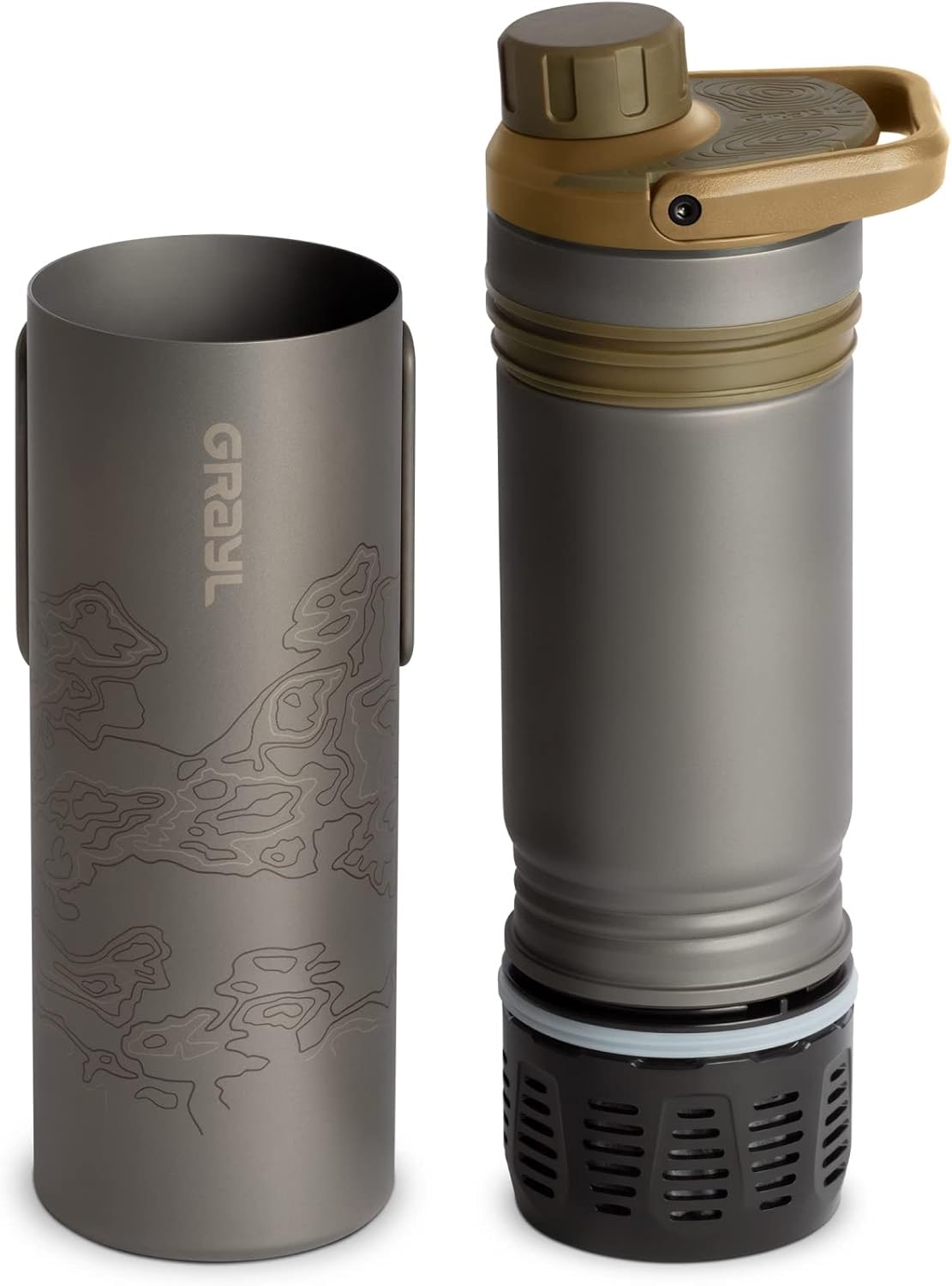
Here’s the stock photo of the beauty in coyote brown, my preferred color:

Before we get too far, you should know that this is an expensive item. There are much cheaper Grayl water bottles than the one I have, as I’ll point out below, but mine retails for $180. Sure, I paid significantly less than that, but in any case it’s pricier than a similarly sized Yeti, for instance, which retails for around $32.
That said, these are very different products.
The most basic difference is that a water bottle holds water, but a Grayl purifies and then holds water. And its purification system just happens to be dynamite. I’ve used many different water systems in my days, but I’ve found nothing as convenient and reliable as the Grayl’s “French press” method. My Grayl has given me quick, clean drinking water from a mountain stream in the Rockies to an old rural well in the Greek countryside. If I’d used a regular water bottle to collect the water and drink it in those places, gastro-intestinal bad times would have followed.
To get these advantages alone, you could get the basic model of the UltraPress, which retails for $75. Am I willing to pay double the cost of a Yeti to avoid a hot date with Giardia? Heck yes I am.
Well, I’m obviously willing to pay even more than that since I use the UltraPress Ti. Before I get into what that fanciness gets me, though, let’s talk sizes.
The Grayl UltraPress has a stated 16.9oz capacity. They make a larger GeoPress, which has a 24oz capacity. It costs a bit more, but the main reason I’ve stuck with the UltraPress is the convenience of it. The GeoPress is about 3.4” in diameter, whereas the Ultra is a slim 2.75” — essentially the width of the average soda can. As a result, the UltraPress is an easy fit for cupholders and bottle pockets. It also weighs a mere 12.5oz empty; the GeoPress raises that to 15.9oz. Bigger isn’t always better, and this is especially true when it comes to daily use. If the bottle is too bulky to go where you need it to go, odds are it won’t go with you.
As I said, the basic UltraPress retails for $75, and it’s a great deal for that. But the version I use is made of Titanium and retails for $180. I appreciate the upgrade to metal for durability (and to get away from plastics), but the big advantage it offers is camp readiness: with an outer cup made of Titanium and equipped with flip-out handles, it can be put directly over a fire or a campstove. Yup. You can purify water and cook dinner in the same vessel, and it weighs only 14.1oz empty. Oh, and if you don’t mind the larger size and price tag, the GeoPress Ti is designed to fit a literal coffee press inside, which looks simply amazing. (I’ve not tried it out, but I could see this addition being enough to sway me to the GeoPress over the UltraPress.)
Put it all together and a Titanium Grayl is a lightweight on-the-road gut-saver, on-the-trail life-saver, and at-the-camp space-saver. An amazing piece of equipment.
Almost Perfect
The Grayl shines in some of the harshest survival situations … yet it stumbles as an everyday water bottle going to work, the gym, or whatever.
Why? Well, if you live in a place with clean water and you’re wanting to “daily drive” your Grayl — I’m a firm “yes” to both of these, as I think most of Grayl’s customers are — you’ll want to pull the filter cartridge out of the bottle until you actually need it. The filters are long-lasting, but the cost of replacing them through daily use ($25 retail for the UltraPress) would add up in a hurry.
Happily, removing the filter is easily done, and pulling it out even adds around 3oz of capacity to the bottle in my estimation.
Unhappily, for purification purposes the bottle’s lid attaches to the inner press, which under normal usage seals against the outer cup with silicone rings at the top and bottom. Crucially, though, that bottom silicone ring is affixed to the filter cartridge that screws into the inner press. So no filter, no bottom silicone ring. This presents two problems. One, the inner press can now more easily pull out of the outer cup, especially if it is full of water (!). Two, a couple teaspoons of water will be trapped between the inner press and outer cup, so you have to take it all apart to clean it or dry it out.
I don’t know why the bottom silicone ring is on the filter instead of the end of the inner press itself. But assuming Grayl has a good reason for this design, I would love for them to sell a “dummy” cartridge for daily use: it would have the threads and sealing ring of the regular cartridge but none of the lower structure and filter media. Such an add-on would be inexpensive — certainly cheaper than the more complex cartridge! — and it would instantly transform the Grayl into an everyday workhorse.

Lacking this, I’ve long used other bottles for my everyday carry. I don’t think it made it into any of the documentaries I shot, for instance, this past summer I used the Vapur collapsible water bottle and was just careful where I refilled it.
A few months back, though, I found a food-safe silicone o-ring — 68mm OD, 61.8mm ID, 3.1mm width — that I can pull around the bottom of the Grayl’s filter-free inner press before pushing it into the outer cup. This extra point of grip prevents the inner press from pulling loose and sending water everywhere, which is a big win. I haven’t used another bottle since.

Going this route is hardly a perfect solution, though. It’s profoundly inelegant, for one thing. Also, it doesn’t fully seal the gap between the two pieces, so I still have to take it all apart to clean it and dry it. But it does make everyday use possible, which furthers my appreciation for this remarkable piece of gear.
Conclusion
There’s a reason I’ve sung the praises of the Grayl for years. It’s a great product and a potential life-saver. Given the price-point, though, it ought to be an out-of-the-box daily driver, too. I’m very much hoping the good folks at Grayl produce a dummy filter to make it so!
Other Grayl Products
A couple folks who’ve seen me using my Grayl have asked about the company’s other offerings, like their camping gear or their intriguing packs. Going by the quality of their water bottles, my assumption is that there’s a lot to like there. But I have not tried them yet. Sorry!
Discover more from Michael Livingston
Subscribe to get the latest posts sent to your email.